
The Durability Case
Buy one washer.
Skip the next two.
The average washer bought today is replaced within about a decade. Speed Queen tests its machines to 25 years of household laundry and backs them with up to 7 years of parts-and-labor coverage — because they're made in Ripon, Wisconsin, USA, in the same factory, to the same standard, as the machines that earn their living in laundromats.
Tested to a 25-Year Design Life
Before a Speed Queen design ships, it runs the equivalent of 10,400 wash cycles in the test lab — about eight loads a week for 25 years. The industry norm is a fraction of that. When the brand says one washer instead of three, that's the test data talking.
Metal Where Others Use Plastic
Steel cabinets, stainless or galvanized tubs and cylinders, metal transmissions and heavy-gauge suspensions. The parts that fail first on a typical washer — plastic tubs, plastic drive components — simply aren't plastic here.
Made in Ripon, Wisconsin
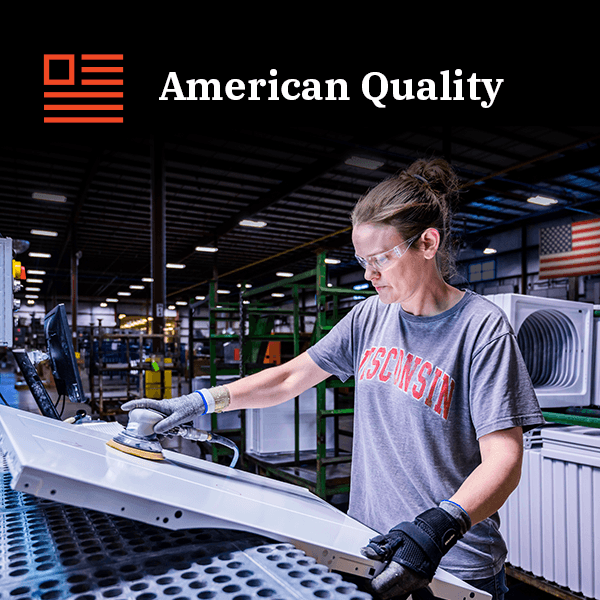
Where is Speed Queen made? Ripon, Wisconsin, USA — designed, engineered and assembled in the same factory complex that builds the brand's commercial laundry equipment. Same lines, same people, same standards — your washer is a laundromat machine that lives in a house.
Read where Speed Queen is made →Commercial Heritage
Speed Queen's Ripon, Wisconsin factory has been building washing machines since 1908, and the brand has specialized in commercial coin-laundry equipment for nearly a century. A laundromat washer runs more loads in a year than a family runs in ten, and it has to keep earning the whole time. That duty-cycle mindset is the baseline for every residential model.
Warranties That Say the Quiet Part
On the top load line the number in the model name IS the factory warranty: TR7 means 7 years, TR5 means 5, TR3 means 3 — covering parts AND in-home labor. (The front load family — FF7, DF7 and the SF7 stack — carries a 5-year term under the current program.) A manufacturer only prices a 7-year in-home labor promise when its failure math says it won't be paying often.
Built to Be Serviced
Machines are engineered for repair access and parts stay available for decades — our own service network still works on Speed Queens from the 1990s. A washer you can fix at year 15 is a washer you never replace at year 8.
The Model Number Is the Warranty
3, 5 or 7 Years — Parts AND In-Home Labor
3-Year Warranty
TR3 · DR3
The entry to commercial-grade laundry.
5-Year Warranty
TR5 · TC5 · DR5 · DC5
The value sweet spot — including the Classic Clean pair.
7-Year Warranty
TR7 · DR7
The flagship top load washer and its matching dryer.
Commercial-grade TV/DV/FV/SV models carry Speed Queen's commercial warranty. Every warranty is factory-backed — and as the selling dealer, we handle the service scheduling for you.
See It, Don't Take Our Word
Inside the Machines
Every metal part, exploded
Inside the TR7: metal where others use plastic
The Ripon, Wisconsin factory
Built in Ripon, Wisconsin
27 years. One set of machines.
27 years of laundry. One set of machines.
Why they run this quiet
Suspension & balance control
What the warranty actually covers
The Speed Queen warranty promise
The Classic Clean wash action
TC5: the Classic Clean agitator wash

Do the Research
Durability Guides
Who Makes Speed Queen? Alliance Laundry
Speed Queen is made by Alliance Laundry Systems, a privately held manufacturer headquartered in Ripon, Wisconsin, with roots in the same town going back to 1908. Here is who they are, what else they build, and why it matters to what shows up in your laundry room.
Why Is Speed Queen So Expensive?
A Speed Queen costs meaningfully more than a mass-market washer, and the gap is not branding. It is where the money physically goes: steel instead of plastic, a commercial drive system, a 25-year design target, and a warranty that sends a technician to your house.
Why Speed Queen Washers Are Built to Last 25 Years
Most washers are designed for about a decade. Speed Queen engineers and tests its residential washers to a 25-year design life. Here is exactly how they do it — metal construction, commercial DNA, and a brutal test lab in Ripon, Wisconsin.
How Long Do Washing Machines Last? 8-12 Years, Usually
Most washing machines last 8 to 12 years — and plenty die sooner. Here is what actually determines washer lifespan, when repair stops making sense, and how to buy a machine that outlives the average by decades.
No Lid Lock: The Speed Queen TC5 Classic Clean
Almost every top load washer sold today locks you out mid-cycle. The Speed Queen TC5 Classic Clean is the one machine in the lineup whose lid stays unlocked for the entire cycle — here's why the rest of the industry locks it, and what you get when yours doesn't.
Speed Queen TR3 vs TR5 vs TR7: Which to Buy
Three Speed Queen top load washers, one wash system, one motor, one tub. The TR7, TR5 and TR3 are far more alike than the price ladder suggests — what you are actually buying as you move up is warranty years and control features. Here is how to pick the right tier.
Why Cheap Washers Break in 5-8 Years (and Speed Queen Doesn't)
You just got a repair quote on a washer that is barely six years old, and it costs a serious fraction of a new machine. That is not bad luck — it is the predictable result of how washers are designed now. Here is what actually changed inside the box, and what a 25-year design life is really buying.
Commercial Washers for Apartment Buildings: How to Choose
Putting laundry in a multi-family building is a different purchase than buying a washer for your house. Here is how the three vend options actually differ, how many machines a building needs, and the required coin kit almost every first-time buyer forgets to order.
Are Speed Queen Washers Worth It? The 25-Year Math
Speed Queen washers cost more up front than most brands — and cost less than almost all of them over 25 years. We run the real numbers: cost per year, warranty value, repair risk, and who should NOT buy one.
Speed Queen vs LG vs Samsung: Durability Compared
LG and Samsung win on features and finishes. Speed Queen wins on decades. A fair, fact-based comparison of design philosophy, construction, warranties, and what repair data says about all three.
Speed Queen TR vs TC: Which Top Load Should You Buy?
Both are built like tanks, so which Speed Queen top load belongs in your laundry room? The TC5's old-school deep-fill agitator versus the TR series' modern Perfect Wash system — differences, trade-offs, and how to choose.
What 'Commercial-Grade' Really Means for a Washer
'Commercial-grade' is one of the most abused phrases in appliances. Here is what it actually means when Speed Queen says it — shared platforms, laundromat testing, commercial components — and how to spot the fakes.
Is Speed Queen Made in the USA? Yes — Ripon, WI
Speed Queen is made in Ripon, Wisconsin, USA — and has been since 1908. Inside the factory: a century of washers, the world's largest commercial laundry maker, and the torture labs behind the 25-year design life.
What Speed Queen's Warranty Actually Covers
Speed Queen's warranty is the simplest in the appliance business — 3, 5, or 7 years of full parts AND in-home labor, and on the top load line the number in the model name tells you which. Here is every tier, what's covered, and how to get every year you paid for.
Speed Queen Top Load vs Front Load: 6 Real Differences
TR and TC top loads, the FF7 front load, or the SF7 stacked pair? Six honest differences — water use, cycle speed, fabric care, ergonomics, space, and capacity — and which Speed Queen format fits your laundry room.
10 Habits That Push a Speed Queen Past 30 Years
Your Speed Queen is engineered for 25 years. With a handful of five-minute habits — right detergent, level feet, fresh hoses, clear vents — owners routinely push these machines even further. The complete owner's playbook.