Buying laundry for a building you own is nothing like buying a washer for your own house. You are not choosing a machine you will baby. You are choosing one a rotating cast of strangers will overload, run at midnight, and call you about at 7 a.m. when it does not start.
That changes the whole decision — how you get paid for a load, how many machines you install, and above all what the machine is made of.
Step one: decide how the machine gets paid for
This fork determines which model numbers you are even shopping. Speed Queen's commercial line splits into three vend types, and the same washer exists in more than one.
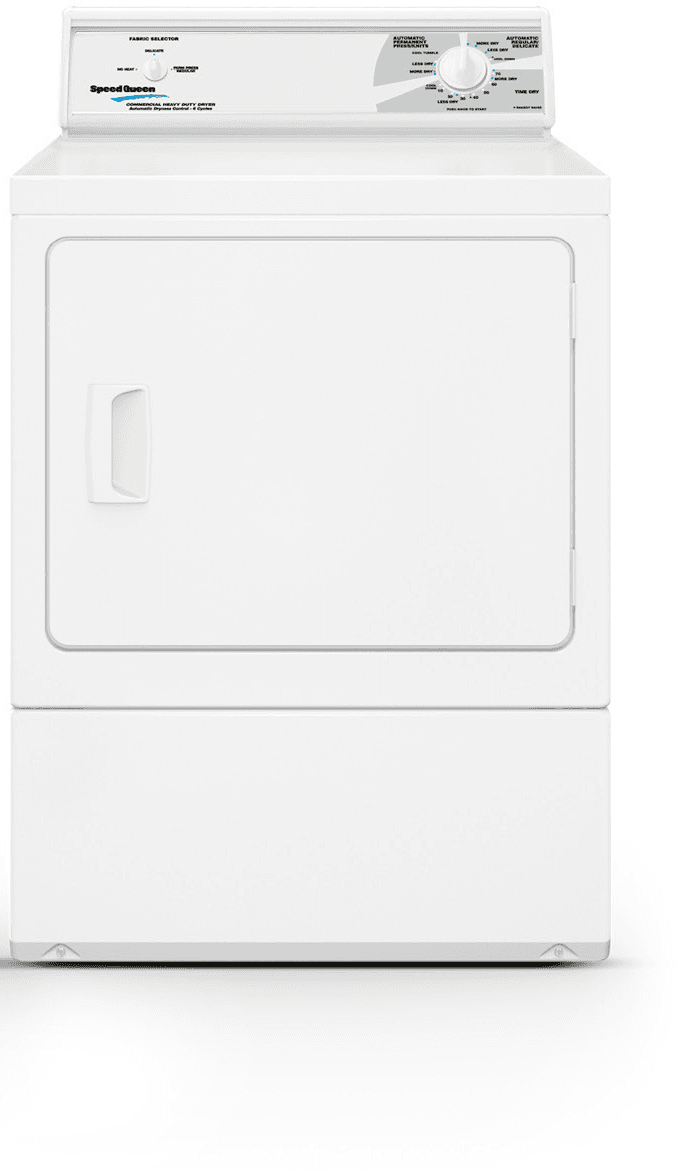
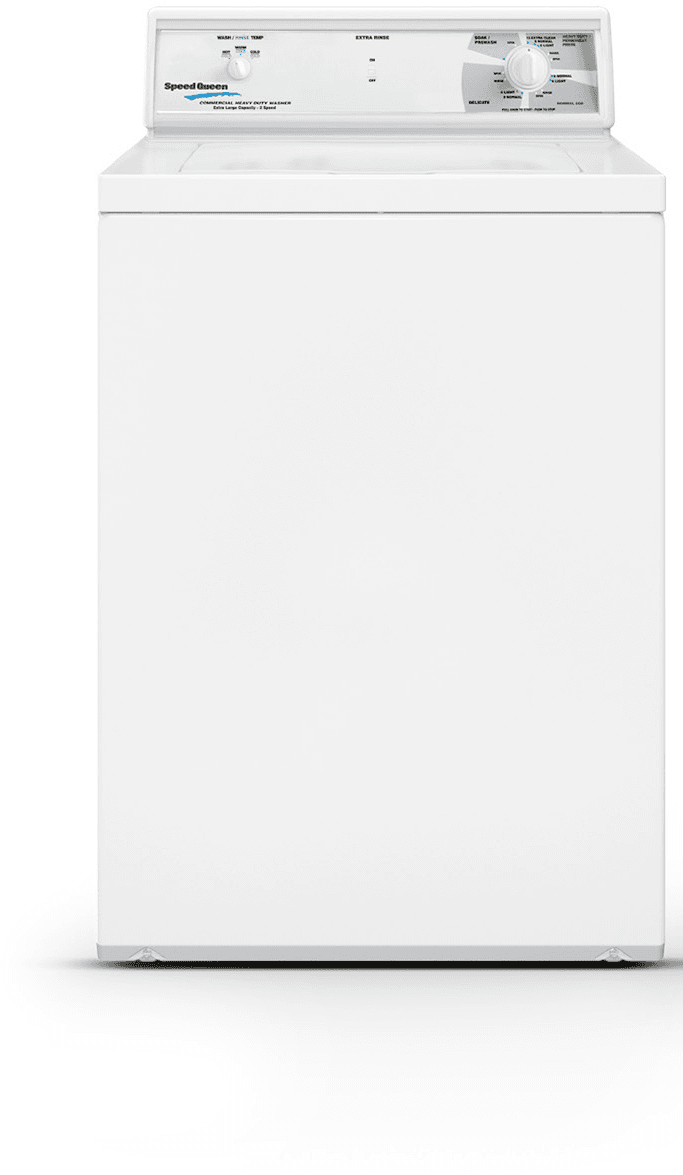
Non-vended. No payment mechanism at all — the tenant walks up and presses start. You absorb the cost and recover it in the rent, or treat it as an amenity that helps the unit lease. The TV2000WN top load washer and the DV2000 dryers (electric or gas) are the non-vended machines. No quarters to collect, no vault to empty, no coin jams, no tenant at your door because the slide ate their money. For small buildings and anyone who would rather not be in the coin business, this is often the right answer — and most first-time buyers do not realize it exists.
Coin slide. The classic mechanical drawer: load quarters, push the slide in, the machine runs. The TV4000WN washer and the DV4000 dryers are the coin-slide models. The appeal is a payment mechanism with nothing to go wrong — no reader, no board, no network — and coins collect behind the slide rather than in a deep vault, which is fine in a building you walk through anyway. (For spec-sheet readers: the slide is the mechanical part. TV4 and DV4 machines carry electronic controls; it is the non-vended TV2 and DV2 that are mechanically controlled.)
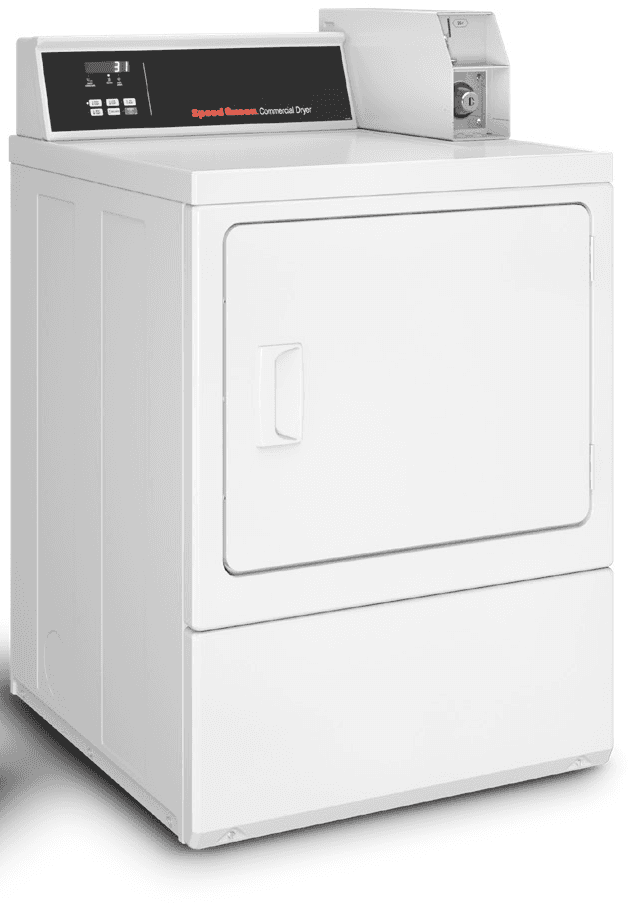
Coin drop. The workhorse for buildings with real laundry traffic. Coins fall into a locking box with meaningfully more capacity than a slide, so collection is a monthly errand instead of a running chore. It is also the widest part of the lineup: the TV6000WN top load washer, the DV6000WE dryer and its DV6010 sibling, the FV6030WN front load washer and FV6020WN, and the SV6001WE stacked washer/dryer. If a dozen or more households will share the room, start here.
The coin kit is required — and sold separately
This is the most common surprise in the category, so we lead with it rather than letting it turn up on delivery day: a vended Speed Queen ships without its coin mechanism. The kit is a separate part number you order alongside the machine, exactly as the Alliance spec sheets specify. Miss it and you take delivery of a very good washer that cannot take a quarter.
Coin-slide machines — the TV4000 washer and DV4000 dryers — require kit CK124, one per machine.
Coin-drop machines — TV6000, DV6000, DV6010, FV6020 and FV6030 — require coin box CK043, one per machine.
The SV6001 stacked washer/dryer requires two CK043. The spec sheet says so in as many words — "(2 required)" — because the washer half and the dryer half each have their own coin drop. Three SV6001 stacks means six CK043, not three.
Non-vended TV2 and DV2 machines need no kit at all — one more reason they are the low-hassle choice for a small building.
How many machines does your building need?
We would rather give you a method than a number, because the answer depends on a building you know better than any chart does.
Start from the doors, not the square footage. Count the units, then picture the worst hour of the week — usually a weekend afternoon. The right number of machines is the number where a tenant who comes down at that hour finds one open. That is the entire specification.
Two adjustments hold almost everywhere. Never install fewer dryers than washers — a dry cycle generally runs longer than a wash cycle, so dryers choke first. And add pairs, not bigger machines: two machines running beats one large one, because a single machine down takes the whole amenity with it.
Being one machine short never shows up as a line item. It shows up as complaints, as tenants hauling laundry elsewhere, and eventually as a reason someone does not renew.
Why commercial construction matters more here than at home
In a house, a washer runs a handful of loads a week for one family that knows how to treat it. In a shared laundry room it may run several times that, fed by people with no reason to be gentle with equipment they do not own: overloaded tubs, doors let go instead of closed, the wrong soap, cycles stopped halfway.
That is duty cycle, and it is what commercial equipment is engineered around. Speed Queen's parent company, Alliance Laundry Systems, is the largest commercial laundry manufacturer in the world, and the machines in laundromats come out of the same Ripon, Wisconsin operation. Commercial owners do not tolerate parts that wear out, so these machines are designed to be serviced rather than replaced. We unpack what the phrase does and does not mean in what "commercial-grade" really means; the wider engineering story is at why Speed Queen.
Owners also underrate the control panel: it is built for someone who has never seen the machine before. In a laundromat that is a customer. In your building it is every new tenant — which means fewer calls to you.
Stacked units when the laundry room is a closet
Plenty of buildings have no laundry room — just a closet at the end of a hallway, or a corner of a basement already spoken for by the boiler. The SV6001 stacked washer/dryer puts a full washer and dryer on one footprint, in electric (SV6001WE) or gas (SV6001WG), with a coin drop on each half. It is the answer for in-unit laundry in smaller apartments and for common areas where a side-by-side pair will not fit. Remember the two CK043 boxes.
The practical checklist before you order
Hookups. Confirm hot and cold supply, a proper drain, and enough room to service the machine — not just to slide it in. A floor drain is a gift; plan the layout around it.
Gas or electric dryers. The SKU tells you which: models ending in E are electric (DV6000WE), models ending in G are gas (DV6000WG). Electric needs the heavy dedicated circuit; gas needs a gas line plus a standard outlet. Both need real venting, correctly sized and actually cleaned — lint is the leading cause of dryer trouble in shared laundry, and the one you control. Have your electrician or plumber confirm what the room has before you order.
Ongoing service. Decide now who gets the call. Buying through an authorized Speed Queen dealer keeps the factory warranty intact and warranty service in proper channels — our Speed Queen warranty guide covers how it is structured.
A straight answer on leasing
People search for laundry equipment leasing constantly, so let us be direct: we sell equipment, we do not lease or rent it. There is no route program here and we will not pretend otherwise.
What we will say is why owning often pencils out better. Lease the machines, or hand the room to a route operator, and neither the equipment nor the income is yours — you are trading a share of the revenue, and control of the room, for someone else's capital. Buy, and the equipment is an asset on your property, whatever it takes in is yours, and a machine built for laundromat duty has a long working life ahead of it. If the up-front number is the obstacle, financing is a better lever than a lease.
Talk it through with someone who has specced these rooms
All Make Appliance is an authorized Speed Queen dealer in Jackson, NJ. We ship nationwide. NJ/NY metro delivery is $99 under $499, free at $499+ (3–8 business days); US Standard Freight is free over $1,298.99.
Browse the coin-op and commercial lineup for live pricing and stock. But if you are outfitting a building, a phone call is faster: tell us the unit count, the room, and whether you want to be in the coin business, and we will tell you which vend type fits, how many pairs to plan for, and which coin kits belong on the order.
Call (732) 631-8800 and ask for commercial laundry. Ten minutes on the phone prevents the two expensive mistakes in this category: buying one machine too few, and forgetting the coin kits.